Aerobic Running

woman_running_jogging_f_600x250

source: ic.studyhealth.com

I’ve been running for a number of years and have never given much thought to the science of aerobic running and its counterpart anaerobic running. Sure I’ve heard the term, and translated it to mean, that if I can hold a short conversation while running then that’s aerobic and it’ll do. Besides, I’m not much of a fan of running and talking, as I prefer to dial-in to what’s happening in and around me, thus silence please has always been my motto. Thing is, all this time with my limited understanding of the term, its application and ability to improve my running, I may have inadvertently put myself at a disadvantage in the PR department.
As it is, after my last race, I’ve been pretty sensitive and receptive to any information that could help shed some light on my performance that day, hence the topic today. According to runneracademy.com, aerobic running is the state of exercise where your body has enough oxygen for your muscles to produce the energy they need to perform. See I wasn’t too far off; if you’re running and you’re able to maintain a short conversation as when you’re doing an easy run, you’re engaging in aerobic respiration. Science has it, that this state of running is extremely important to runners and will allow your body to become stronger while recovering from harder bouts of exercise (underarmour.com, Health & Technology blog).
The case is made for spending at least 80% of your running in an aerobic state to become a faster runner. Some coaches  even argue that aerobic base training is integral to a successful runner’s training plan. This type of training, championed by Matt Ross USAT, USATF, USAC coach, is a period of reduced volume and intensity, working in the presence of oxygen – slowing it down in order to get faster. Matt argues that it is impossible to train hard year round, without taking regular periods of reduced intensity as this is sure to affect your performance negatively even if you don’t fall suspect to overtraining, injury or just plain burn out. In an article on active.com, Aerobic Base Training: Going Slower, to get Faster, he says,  “the idea behind base training is to train your aerobic energy system specifically and solely. Prolonged aerobic training produces muscular adaptations that improve oxygen transport to the muscles, reduces the rate of lactate formation, improves the rate of lactate removal and increases energy production and utilization. These adaptations occur slowly over time.” From my understanding, this period of base training teaches your body to utilize fat more efficiently as its main source of energy as it is the primary source of fuel for the aerobic energy system as oppose to carbohydrates, which is mainly what drives anaerobic running. As you would have guessed by now, Anaerobic running is the out-of-breath, all-out, over-your-threshhold kind of running, when your body does not have sufficient oxygen and therefore will be unable to sustain the current pace for a long period of time.
A lot has been written about how the body utilizes and expels carbon dioxide and water natrually while we run aerobically and produces lactic acid when we switch to anaerobic respiration. The danger lies where there becomes a build-up of lactic acid and therefore a byproduct of its production – hydrogen – because of a low supply of oxygen in our system. This leads to extreme fatigue and thus the inability to sustain such a state. We can see how that is a problem for a marathoner or long distance runner. Ideally you want to utilize aerobic running for the most part of the marathon, switching to anaerobic running to finish off or finish strong, as we like to say. What that will look like for each runner will differ as we all have different fitness levels. For this reason coaches recommend performance testing to determine accurate individual zones which leads to a better understanding of one’s lactate threshold and thus one’s aerobic fitness level. 
I suspect I’ve only scratched the surface on this important area of running performance and only just begun to grasp its significance in training for the marathon in particular. Even the tevhnical jargon (LTHR, VO2 max, heart rate/ individual zones) isn’t Greek anymore and true to form, I’ve made a concentrated effort to apply its wisdom in training for my next big one coming up in July. I expect there won’t be results as immediate as I would like and maybe not even in July, but I figure to give it a start and in the words of Coach Matt, “the sooner you get started, the faster you’ll be.” I’m hoping anyway.

Summer Fun Runs Allowed

source: healthista.com

source: healthista.com


One of the best things about Summer and nicer weather for us running folks is the mix of wild and crazy runs out there. Time enough for the serious long races; summer is about getting out; adventure, travelling, and discovering the free spirit within. All the better if you can do it while running and in a group; just add some color, mud, friends and obstacles and what you are promised a summer you’ll remember for some time.

Based on my experience and a bit of digging around, I’ve put together a list of eight of my favorite races for some of the best fun running around these United States. Here are my “easy” (wink) running picks. Hmm decisions, decisions…

(1) Rugged Maniac 5k & Obstacle Race, Brooklyn New York, June 25. A combination of about 26 obstacles including Piromaniac, Leap of Faith and the Warped Wall.

(2) Wicked Wine Run, Houston, El Paso, Fresno CA, Louisiana just to name a few this Summer with many other locations in Texas and a few other cities all the way through Fall.

(3) Tough Mudder, Long Island NY, July 23, 24. Option for 10-12 miles, 20+ obstacles or 5 miles, 14+ obstacles. Obstacles include the block mess monster, swing arm, electroshock or cold shock top and a lot more.

(4) Rock n’ Roll Chicago Half-Marathon, July 16-17. Fun Option: run the 5k on Sat & the half-marathon or 10k on Sun and you earn the spinning guitar remix challenge medal.

(5) Reebok Spartan Tri-State New York Sprint, June 18-19, 3-5 miles, 20-23 Obstacles. Vie for the fastest finish time.

(6) ROC (Ridiculous Obstacle Challenge), June -NYC, June – SoCal, July – NoCal  and August – Washington DC & New England. A fun, untimed race with 12 larger than life obstacles.

(7) Warrior Dash, from May 14, till early September from Maryland then New York to Colorado and everywhere in-between. 3-4 fierce miles featuring 12 extreme obstacles including leaping through flames and over the vertical vicious valley. You could earn a spot to compete in the world championships for the grand prize of $100,000.

(8) The Color Run; June, July & August at various locations in Pennsylvania. It’s the original paint run dubbed the happiest 5k on the planet. Of course they’re all over the country throughout the year but it’s happening in PA.

There’re a lot more summer races: for fun, bragging rights, competitiveness, challenge and yes, prize money too. For almost every one of them, you can pitch in for a good cause, which is super worth it. The way I see it, running can at times be not about the marathon, summer is the reason, plus more often than not it’s way too hot for that sort of distance anyhow. The rest of the year is all about training and racing so if I can get a couple runs in, for variety sake, heck yeah!

A quick disclaimer: races appear easier than they actually are and though fun can be grueling and extremely challenging; a slighty above-average level of fitness is required. Be prepared in most cases to get down, dirty and bruised. And finally, race at your own risk but always with company as that’s a big part of the fun.

Post-Marathon: Recovery is Cool

I don’t regret my painful times, I bare my scars as if they were medals. I know that freedom has a high price, as high as that of slavery; the only difference is that you pay with pleasure and a smile, even when that that smile is dimmed by tears. – Paul Coelho

Two weeks, I am told, two weeks off will make it all better. Promises..promises. I’m kidding of course. As disappointing as my last race was and as much as I am tempted to get right back in and push at doing better, training harder, running faster, wisdom has it that I stand a much better chance of performing better in the long-term if I recover well.

The idea of recovering after a marathon, giving your body time to heal, is not a new one and is touted by many pros and coaches as necessary and even critical for maximising your long-term potential. It is true that I’ve never paid much mind to this strain of thought before now, but then I am a believer in listening to your body and the truth is mine was crying out for some rest. That doesn’t mean it was an easy decision to make, on the contrary, it took a friend of mine pushing none-to-gently (we all need friends like that) and finally being struck with the cold to get me to capitulate and surrender myself to two weeks sans running. I felt so terrible the first week – due to the cold firstly and then because I couldn’t run – I couldn’t even go to the gym to assuage my sense of deprivation with a workout and was forced to rest. Seems one benefit of recovery is to boost the immune system to guard against viruses, colds and such. Any wonder I needed it? During this recovery period, the focus is on muscle and cell repair and giving my immune system the boosts it needs by resting, sleeping and eating well.

Once I’m working with a goal I’m much more receptive, so this past week hasn’t been so bad. I’m on the mend and proved it with some gym classes, consider it light cross-training. Next week, I’ll resume with some light running as a slow build-up to getting back in training mode. No surprise there..I’m a runner aren’t I? There are races to run, new courses to discover, runners to meet and hopefully PRs to be made. With Boston 2016 behind me, though the disappointment will be with me for a while, I’m relieved and anxious to see what this new running phase will bring. Also, I’m looking forward to shaking things up a bit in the hopes of garnering better results. This is me; always looking at ways to improve as an individual and as a runner; the responsibility and power to do so is mine.

blog2~2

source: womenfitness.co.uk


The Boston Experience: 26.2 but how

IMAG0047

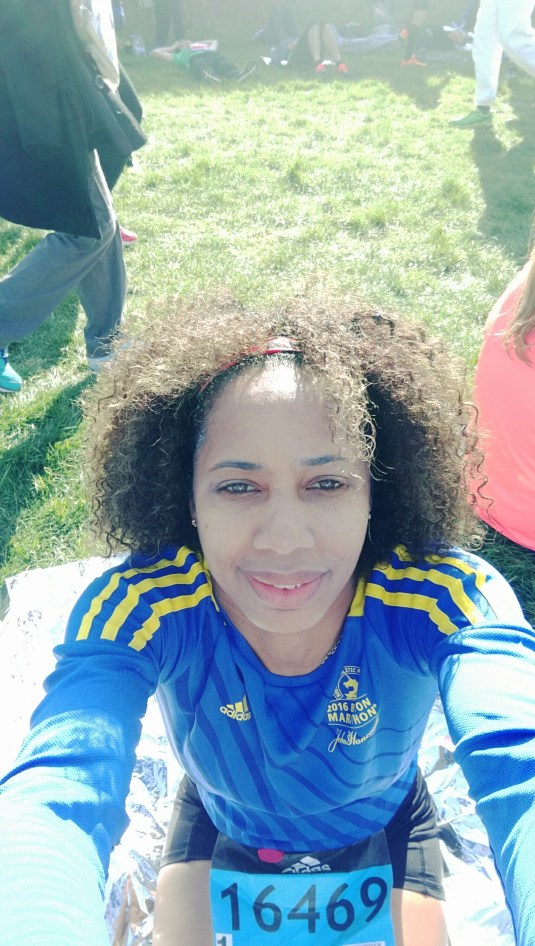
Pre-race @Athletes Village

So much of life depends on how you handle what is thrown your way. Too much of it has the power to define you, your ability, perspective, attitude and even cause you to question your belief in yourself..if you let it. My Boston run was everything I could never have anticipated.

As an athletic person – yes, that’s what I consider myself, not a pro by any means but one just the same – you always think you’re ready for the unexpected, you can deal, until it happens. By now you’re guessing it didn’t go down well, and you’re right, it didnt. No matter how prepared I told myself I was, I just was not prepared for my body to check out of the race hardly before it had begun. As it is, I will forever remember mile 4 as the point where my body not just disappointed me, but failed me miserably.

There are always reasons and excuses for not running a good time on any given race day and I will not fall into the trap of assigning blame. Frankly, I’m only interested in what can help me to understand what happened out there on the course, that no matter how hard I pushed or what I told myself during that run on Monday, I couldn’t get my body to co-operate with my mind. Maybe if I understand, there may be a way to make sure it never happens again. If you can, imagine running 22 miles with, not in, your mind; it was just about the hardest thing I’ve ever had to do. It felt like a mile by mile battle of wits except I was fighting myself and could hardly understand why. This left me confused and unable to truly appreciate the course and crowds, which by all accounts were phenomenal and so typically Boston Strong. In all honesty, I cannot even blame my breathing issue, sure I had a bit of a struggle there, but it was not insurmountable, not like the unknown that I was faced with.

So what did I do? Well , I did what any one in my running shoes would, under those unknown circumstances, I ran with my head; my only thought to cross the finish line with some dignity. You may ask, at what cost? Well dearly I’ll say: an official finish time of 3:59:14 – no where close to my goal and so there goes my pride, my time, training and so many other little investments unrealised. Such high hopes and plans all dashed to pieces, pieces, by the grace of God I was able to pull together and drag to the finish.

Still, I’m thankful I have my life and limbs, with which I live to run again. My health though remains an open-ended question, I can only hope the doctor has good news as I’m in dire need of some just about now.

A Marathon Frame of Mind: Boston Strong

Sports-Illustrated-Boston-Strong-2014-spread_1

source: wcvb.com

Just a few more days left to go, two and some to be more precise, and for a while there I was wondering if it would ever get here. Now there’s a part of me silently screaming that it’s all too much too soon, while the other part – the marathoner – is yelling to bring it on.

Only one time before have I felt anything other than excitement at a big run such as this, you may recall my first marathon – the New York City Marathon – which I ran with a sprained ankle. Back then, I had a similar feeling of trepidation, which didn’t result in any great feat accomplished except to probably make me the only person crazy enough to run 26.2 miles with pain and a hobble. Fast forward to Monday coming, seven marathons later and a 100% belief in my ability to finish.

Today’s bit of anxiety really stems from “the elephant in the room” also known as my breathing problem and now becoming popular among athletes, Exercise Induced Asthma. My acceptance of this diagnosis is cynical at best while the reality is much less so and one I must run with; and so my concern is really about my finish time. This may seem silly – here I am with a very real health issue and yet all I can think about is a goal time. Well try not to judge me too harshly. I promise you, run enough marathons and the question becomes not about finishing, which is a given, but only “in what time.” That being said, I’m by no means nonchalant about my condition, only aware of my body and its evolving boundaries, which I think I’m becoming quite good at exploring and extending bit by bit. This is my comfort and that which gives me hope going in to Boston.

I can absolutely do this. The training is done and I’m as ready as I will ever be at this point. I look forward to a phenomenal experience: the new course, amazing spectators, good weather (we can only hope), and an all-round fun time. Determidly so, I might add, because I’m mindful that I’ll be running in the footsteps of all those who have gone before me, in the spirit of all those who hope to come after and for those who can only dream.

As such, in the spirit of Boston, on this the third anniversary of fhe Boston Marathon bombings, along with the survivors and those who lost their lives on that fateful Marathon Monday in 2013, I promise to run Boston Strong.

All the fuss: The Marathon Taper

Source: running magazine.ca

Source: runningmagazine.ca

Yes, I had to go there. While so much have been said about this important component of marathon training, some of us may still be a bit confused with all the information and cross information out there. Tapering is concisely defined as a reduction in training before a big event (runnersworld.com). Well, simple enough right? Except, with runners, it rarely is. There are many differing views on the form, duration and intensity this Taper should take. I, for one, think the concept is important but “tweak-able” as there is no one-size-fits-all in running, only a training method or plan tailored to suit the individual runner.

A comprehensive marathon training plan will include the taper element if only to make sure of its success, as it is nearly impossible to think of the human body undergoing the rigorous training inherent in such a plan and not be given the time to regroup, recalibrate and detrain..for want of a better word. Some pros argue 3 weeks, others say two. Really, it should fall somewhere in-between there but largely be based on your level and intensity of training. Studies and reports across the running spectrum has lauded the benefits of tapering to your marathon performance and goal time, siting improved and sustained race-day performance: increased energy, strength, confidence and endurance as ways in which runners benefit from this training mechanism. Pros and coaches alike also agree that during this period of – cutting back – the body re calibrates itself through muscle repair and recovery, increases muscle glycogen, and boosts muscle power, while the mind de-stresses, which reduces mental fatigue and enhances mental efficiency. It also allows for an important factor, reducing the chances of over training, which  can lead to a less-than-fresh feel heading into the race and even put one at risk for injury leading up to race day.

Experts say the key to a successful taper to ensure maximum efficiency on race day is to find the right balance between three key training elements: duration, mileage and key workouts (competitor.com). For me, that means I’ve cut down my mileage to around 75% this week, next week I’ll bring it down to 50%, while my focus is on running longer intervals at tempo and marathon pace with my speed work dropping to 1 day p/week for 1 hr. I have one medium long run planned this weekend at marathon pace and 1 hr of cross-training at the gym. Next week, leading into the weekend, will see a slight tweak to this plan as I eliminate the medium long run, which will pretty much wrap up my tapering as I head to Boston and Marathon Monday.

I tend to be not much of a rule person and have more-often-than-not found my way by finding what works for me through trial and error. However, in the last couple years, I’ve come to trust the taper method to take me through a race and to the finish line, that is, the few times I’ve not been injured. And so, true to form, I’m in full taper mode and trying my darndest to still the chit chatter of voices in my head that bemoans my current reduced-running state. It’ll be alright I’m sure; listening to your body is key and so is finding the right balance that works for you.


When it’s OK to Tweak Your Expectations

Running is so symbolic of life. You have to drive yourself to overcome the obstacles. You might feel that you can’t but then you find your inner strength, and realize you’re capable of much more than you thought. -Arthur Blank

If running has taught me anything it is the art of adaptation; art, because surely it’s something that you learn and develop over time with practice. Not everyone can flow with the tide and adjust themselves – their attitude and training – to effect the necessary changes that may be needed at the drop of a hat.

As a runner, this is precisely what you can be called to do even at the height of training. How well I know. Post 13.1 race last weekend, I made the decision to alter my pace and strategy for the Boston Marathon in about four weeks. I’ve convinced myself that it’s for my good; to ensure that I have a good race and finish strong. To this end, I’m looking at a 3:45:00 finish and will pace myself accordingly. Taking the course into consideration, it appears mainly downhill and flat and should require a steady medium pace until the hills roll in; this is where real effort and training will come into play.

More than anything, I aim to be careful of the mind game that plays out amidst the fervor of supporting crowds and other runners; the penchant I have for increasing speed when I feel strong and I’m surrounded by like-minded runners. This will present a very real challenge for a competitive runner as myself, as I will have to be careful to stick to a predetermined plan with the option to speed things up only in the final leg of the race. But we’re talking adaptability here and I’m holding myself to a high standard with nothing more or less than a personal desire for success as my motivation to follow through.

It never fails to move me how resilient and strong we can be. How often do we doubt ourselves and out abilities – we being our own worst critics – yet when placed in circumstances that require more than we seemingly have, we, more often than not, exceed our own expectations. I envision a time when belief in ourselves will propel even the believed weakest amongst us to soar to unimaginable heights; when the races we run will be those that we’ve only dreamed about. Truly, we are stronger than we think.

running-fatigue1

Source: sandiegonewsroom.com

Why a Tune-Up Race Is Important

irish

Four weeks out and I figure now is as good a time as any to gauge how I’m holding up in a half marathon – my practice run – and hopefully I get the pot of gold aka a PR.

While there are many reasons for running a tune-up race when training for a marathon, chief among them is the opportunity to ascertain one’s state of preparedness for the big event. This can be done by running a simulation race of sorts to mirror the actual goal race or as close to it as possible given the difference in distance and course. The idea is to practice pacing, breathing and fueling so as to work out any kinks that may arise. I have already decided I may have to adjust my marathon goal pace with the discovery of my recent condition; however, I’ll wait and see how this run goes before making a decision.

Hence my dress-rehearsal tomorrow at the St. Pat’s Rockaway Half Marathon. Thirteen miles along the broadwalk with the ocean stretching into infinity might turn out to be just what I need heading into Boston – at least I’m hoping. While there are no shortage of races to choose from around this time in these parts, I chose an unknown course and a relatively minor half in order to have a quiet and focused run. I will have a slight strain going in, even so, I’m hoping for a PR to satisfy my training thus far and build my confidence as I head into a final week of full-out running before slowing it down in the two weeks before the marathon. With that in mind, I’m testing out my racing strategy of starting out with a moderate pace and slowly building to a fast finish.

That being said, we all know things rarely work out as planned and there’s still the uncertainty of the weather to contend with; be that as it may, I plan on only concerning myself with the things within my control. Even though God’s got those as well, He especially holds the unknown in His more-than-capable hands. Wish me the luck o’ the irish or even better.. I’ll take your prayers.

            🍀💚😜💚🍀

March like a Superhero

Jeremyleerenner.com

Source: jeremyleerenner.com

Somewhere in the near future there are warm sunshine and happy skies and green trees and daffodils and birds singing and enjoying running and picnics and bike rides and nature walks and photography and smiling families and noisy parks and dogs chasing frisbees and children chasing dogs and single layers and shorts and new running shoes… somewhere.

The days are flying , I am running and Boston is seven weeks in coming. In essence, time is marching on. I live for warmer weather, warmer people, warmer smiles, warmer runs – life all stretched out, warm and wonderful – and to rejoice in the advent of Spring and the promise it brings; the promise of new life, hope, new growth, new opportunities and endless running possibilities.

For now I’ll just continue my relentless cycle of training: late-evening, cold weekday runs/drills and weekend long runs requiring twice the effort with some gym work and cross training tossed in for good measure. Seems even running can be a bitch at times but I’m reassured that even that too shall pass. Just like a superhero, March has saved the day.

The Science, Sport and Success of Running

fast-feet

stlhealthandwellness.com

So many of us run for the heck of it, because we can, with narry a thought to the restrained passion inside us – a leashed and unfulfilled drive with unfathomable and explosive potential waiting to happen.

Running is arguably one of the most challenging sports to be successful at. Many would say, “well that depends on your definition of success,” as some see success as being able to get out of bed and jog a mile, while some define success as completing a 5k. Yet still, there are those who think of success in terms of the medals they earn and/or the prize money and place to be won at a race. However defined, success makes the case for a science behind running the Sport and not just for sport.
The very nature of running demands a free expression, hence why we have so many different types and levels of runners. However, it also speaks to our reasoning and methodology. The various reasons that provide the impetus for our stepping out could range from self- motivation to survival and everywhere in-between. All this does is give us a nudge in the right direction, however we arrive there having little impact on how we do going forward; our success or lack thereof will depend largely on the method we use to develop our running ability and garner finesse.
Additionally, it is a Sport that cannot be contained in a box but allows the runner the liberty to be; by the same notion it leaves the responsibility for maximizing its potential in our sometimes less-than-capable hands. We often don’t see the genius in ourselves – being our worst critics – and so never invest in realizing our true running potential.
Here are a few ways we can go about investing:
1. Educate ourselves on the nature of running through educational materials either written or made by experts in the field such as professional runners, coaches or ex-pros.
2. Run consistently, while assessing our competiveness and ability through races.
3. Join a running group for encouragement and accountability
4. Engage a coach to help with techniques and training for races to increase speed and efficiency
5. Follow a plan incorporating a regular running schedule with healthy eating habits and aspects of cross training and exercise to fuel runs
6. Believe in ourselves and be realistic about our ability and expectation, surrounding ourselves with those who will affirm and support our dreams.
While many runners can identify with the above, there will those who argue that running is either not for them or not to be taken too seriously. To each his own I say, but I’m a  firm believer in putting your best foot forward and giving your natural abilities a fair chance before making a life-altering decision. Whether the choice is to be a successful runner, to run for fun, or  not to venture out at all – crazy but possible, a more true saying does not exist, “don’t knock it before you try it.”

Previous Older Entries Next Newer Entries

Enter your email address to follow this blog and receive notifications of new posts by email.

Join 288 other subscribers