Tips to a PR in the TCS New York City Marathon

Chief Petty Officer Noah Bray from Coast Guard Sector New York crosses the finish line at the 2014 TCS New York City Marathon, Nov. 2, 2014. (U.S. Coast Guard photo by Petty Officer 3rd Class Frank Iannazzo-Simmons.)

Chief Petty Officer Noah Bray from Coast Guard Sector New York crosses the finish line at the 2014 TCS New York City Marathon, Nov. 2, 2014. (U.S. Coast Guard photo by Petty Officer 3rd Class Frank Iannazzo-Simmons.)

It’s nine days to Marathon Sunday here in New York City. For a lot of runners that means nine days of excitement, anticipation and tapering. For many others it may mean nine days of trepidation, anxiety and stress. It doesn’t matter where you fall on the emotional spectrum, your feelings couldn’t be more valid as it relates to this marathon. Trumped as perhaps the best and one of the more challenging marathons out there, the hype is real and you will need all of your wits and will to master this course and wring a PR out of it.

The competitive runner understands that each race is different and that despite a well-executed training plan one has to be ready and willing to look at all avenues and consider all possibilities if the aim is finishing within a goal time.  As it is, the TCS New York City Marathon boasts a field size of 50,000 runners, the largest in the world, who are geared up to run the race of a lifetime hoping for the experience of a lifetime. It will be their special time on the running world stage where everyone gets a moment to shine – a shot at glory – if you will.

As a two-time New York City (NYC) and all-round ten-time marathoner I have found this to be a tough and challenging course if you’re running for a goal time. If you’re simply wanting to finish, then you can easily do that, the crowds will get you there. However, if you’re looking for a personal best, a PR or sub 3:30, whether you’re a newbie or a repeat marathoner, you may want to bear these pointers in mind:

  • November’s weather can be very unpredictable. In the days leading up to the race pay careful attention to weather advisories and prepare your body by eating well – carbing up, hydrating well and resting well. This is standard pre-race procedure and will serve you well on race day in being alert, focused and feeling energised.
  • Use a foam roller or the stick the night before race day to get out any kinks or muscle tightness. Roll out leg and thigh muscles especially, it leaves you limber and loose and ready to run.
  • Dress appropriately. Use layers that can be efficiently discarded on the course since it’s very likely that the start will be cold. I like to run at least the first three miles with a heat sheet so my body temperature slowly builds to comfortable race temps, then I discard it.
  • First time marathoners or first time NYC marathoners should be wary of the start. If you’re in the early corrals, the start can be really packed and chances are you’ll be running toe-to-toe with other runners for a few miles, be prepared to adjust or slow your pace to accommodate this.
  • Engaging in dodging and weaving in the early segments of the race utilizes a lot of energy and can cost you later on. It is better to follow the crowd while awaiting the opportunity to increase your pace.
  • It is also very easy to get caught up in the crowds and excitement in the beginning, be wary of going out too fast too soon; pace yourself and stick to it until you’re at least half-way there.
  • Ideally, you want to go for a negative split and up the ante at the halfway point, just be careful to increase gradually.
  • To stay properly hydrated and energized, I would suggest a grab and go strategy at each fuel station indulging in a brief sip before discarding.
  • Alternate between water and Gatorade if available.
  • Add energy gels every four miles after mile 8 (miles 12, 16, 20, 24).
  • Try not to stop at the fuel stations and stick to the outside of the pack in order to get to the middle or end of the tables to grab your fuel so you don’t get caught up in the rush at the onset of the stations.
  • Drink just enough fuel. This a good strategy that will save you time, energy and discomfort as you want to minimize or eliminate any bathroom breaks or any stops at all as this will impede your goal time.
  • Appreciate the crowds and volunteers who are there to make your race experience an amazing one. Buy into the cheers and raves and encourage them with a smile, a wave, a clap and/or a thank you; it adds to your momentum especially in the latter part of the race when you’ll be needing all the encouragement you can get.
  • At this point it will be helpful if you have a number, name, country, or cause on display that the crowds can tie you to. They will use it to call you out and cheer you on and you’ll appreciate that.
  • Look out for the Queensborough bridge ( you cross five bridges in the NYC Marathon), it’ll be around mile 16, at this point you’ll be on the threshold of tiredness and pushing real hard. If you can keep the momentum going up this seeming mountain then you’ll be rewarded on the other side with the rising crescendo of voices, all cheering for you. What a thrill! You’re treated to the screams and cheers of what feels and may very well be a million spectators, from all over the world, as you enter 2nd Ave in Manhattan. This is the reason you run, there’s no greater feeling for a runner than right there and then. Remember that and own it.
  • Running down Fifth Ave from the Upper East Side in Manhattan may feel like the toughest part of the race for some, it appears to go on forever ( for about four miles) lean into it, use the energy of the crowds to push you and provide momentum heading into Central Park at 72nd Street.
  • Now is the time for what I call the fishing strategy: keep your eyes on the runner just ahead of you and slowly aim to pass him or her ( as if to reel them in). This will do two things: give you an immediate goal , which feeds your competitive spirit, and take your attention off yourself and whatever discomfort you may be experiencing.
  • Use the downhill in the park, lean into it and glide. On the other hand, power through the inclines feeding off the crowds and knowing that you’re almost there – less than a mile and a half away at this point.

Finally, getting out of the park and onto 59th Street/ Central Park South, it’ll be your quarter mile final stretch before heading into the park once again at Columbus Circle. You’ll hear the roar of the crowds, see the flags lining the roadway to the finish line area as you get into your final turn, the voice of the announcer and spectators will be urging you on; enjoy it, smile for the camera, finish strong. You did it.

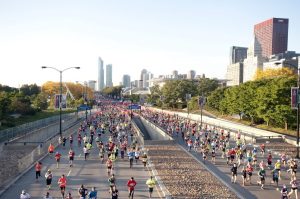
The Chicago Marathon, my running sweet spot

source: bankofamericachicagomarathon.com

@ the start line          bankofamericachicagomarathon.com

Last Sunday 40,400 runners crossed the finish line in Grant Park at The Chicago Marathon. We weaved a determined and exhilarating path through the streets of Chicago, from the downtown area through the suburbs and neighborhoods, out to the medical district and back. Runners came out in their numbers, each wanting their moment of glory, some with personal goals, others as part of a collective effort to raise money for a favorite charity. Whatever the reason, we embraced the warmth, cheers and encouragement of over 1.7 million spectators and thousands of volunteers to cement this, at least in my mind, as the most superbly organized marathon event I have run thus far.

The New York City Marathon runs a close second to Chicago because of its phenomenal crowds and volunteers and because..well, it’s New York. I don’t for one second take for granted how challenging it must be to pull of an event of this magnitude in any city. We, runners, are just super thrilled that organizers of these racing events have the experience and know-how to make it happen and thus afford us these epic moments. Because this was my second time around in Chicago, I was prepared for am amazing race. I had such a good time last year even with a slight injury; this year I had no such encumbrance and felt that as long as I was well rested I would do well. While circumstances did not permit such ideal conditions – I missed my flight on Friday and got in Saturday afternoon, which is an entire blog by itself – for various reasons, many having to do with optimal training (no over-training this time), better rest, hydration and diet in the weeks leading up to race day – all somehow conspired to make sure I ran amazingly well.

bankofamericachicagomarathon.com

bankofamericachicagomarathon.com

Chicago is a beautiful city with a diverse populace and a common passion, or so it seems – a love for running and the marathon. Because I always credit the success of a race in large part to its spectators and volunteers, I truly appreciated the huge turnout on both counts. I maintain there is nothing in the world quite like running down the home stretch of a race to the tune of a roaring crowd urging you on while suddenly hearing your name announced over the loud-speaker as you approach the finish line. That is one of the remarkable moments, and there are others, that we, runners, run for. That and the medal of course.

Like ever race though, this one was different and special. Foremost was my reason for running, I felt so motivated to run for the kids at St Jude’s to the extent that I kept up an average 7:45 min/mile pace for most of the race. My intent was to try for a negative split but I ended up running faster in the first half, then fluctuating a bit, then dropping down to a 8min/mile until mile 24 where I was able to up the anté and run my fastest time through the finish line. I finished at 3:27:11 – my fastest Marathon and a personal best. I was/am thrilled. However, like most type A personalities, I’m quick to see that I could have done better. Because I  was scared of running out of energy, for the first half and a bit beyond, I consciously reigned in my enthusiasm, which was probably wise, as it ensured I finished strong, but it’s also possible I could have put out just a little more, since at the finish I felt reasonably strong.

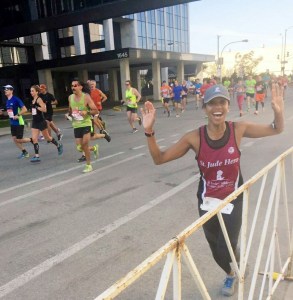
me @ around mile 15.5 in Chicago's medical district

me @ around mile 15.5 in Chicago’s medical district

Oh well.. hindsight remains what it is while I remain committed to improving that time. My next big race is the Boston Marathon in April while I volunteer at New York City Marathon next month. In the meanwhile before Boston, chances are looking really good for another race.

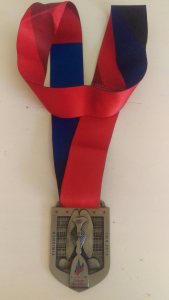
2016 Bank Of America Chicago Marathon Medal

2016 Bank Of America Chicago Marathon Medal

Run Faster Still with Better Form

The Olympics games are over. Bummer of course, but life goes on as must we. As promised, taking up where we left off last week, here are some practical tricks/tips, if you will, to speed up your everyday runs and help with better form. As you will see not all of running is hard work, there are various ways we can tweak workouts to make allowances for a bit of fun.

1. Run Hills – whether as part of speed work training or as part of  your long run, at least once a week, hill repeats are bound to make you faster as it develops aerobic capacity, leg strength and running economy.

2. Sprints – weekly sprints can add variety and fun to your workouts while increasing stride power and running economy, even better if you can get on the tracks to do so.

3. Proper Arm Movements – can power your runs and ensure running efficiency. The forward and backward motion of the arms should remain short and to the side while running and should increase in power and momentum with increase in gradient and speed.

4. Core Exercises  – strengthens the core which allow runners to tap into more force and speed out on the road. Core work can also be fun and easy to do as it can be as easy as a crunches in front of the television or a Barre or Pilates class.

5. Good Breathing Technique – allows for better oxygen distribution through the body which ensures you’re able to run at aerobic capacity longer. As such, using the nose and mouth while inhaling and exhaling will get the maximum amount of oxygen to the muscles.

6. Staying Focus by Looking Ahead – staying in the zone by keeping your eyes ahead while running/ racing and giving oneself small goals to reach will keep you pushing the pace and elimate the chance of getting distracted.

7. A Hot Running Playlist: songs that make you sing out loud, shake and get your adrenaline flowing will add a boost to your step and some sparkles in your eyes maybe?

8. Forefront Running – runners who land on the forefront of their feet and not the heel has a faster step turnover which translates into a faster pace.

9. Stretching and Yoga – practicing good stretching techniques before and after runs guards against injuries but practicing specific yoga poses for runners increases flexibility and fluid, limber movement, which boosts speed and  has the added benefit of aiding recovery post workout.

10. Less is Better – when all is said and done running efficiency can be achieved with as little as possible in the way. Do away with all the extra layers and embrace the minimum in terms of running gear to get a faster time or pace.

I’m sure there are lots of other ideas on this topic so please take the time to share whatever has worked for you as we’re all in the business of getting better at our running game. And please, give some of these a go, you’ve got nothing to lose but time off your last run.


Team: Run Faster

Usain Bolt, 3x Olympic champion 100m, 200m

Usain Bolt, 3x Olympic champion 100m & 200m

Which runner do you know that doesn’t want to run faster? Who wouldn’t want to do a better time or run a faster PR? No one I know. Rarely will you find a runner who is contented with just being average; and if you think you have, then I’d go so far as to say, they’re visitors ( for want of a better word) and not really runners at all. Runners are a mostly competitive lot. Whether we’re competing in races or among each other or even with ourselves, the goal is always to improve. While improvement can vary to include better form, more endurance and/or strength, it ultimately translates to becoming more pace efficient or a faster runner.

One can never be too run savvy, not unless you’re an élite or pro and even then, I’m sure they keep up with relevant and new information as it pertains to the sport. They must in order to stay on top of their game and so too should we. As such, here are a few pointers I have found that ishelps with increasing speed and can make you a faster runner:
  • Speed work: tempo runs, hill repeats, interval and fartlek training increases your anaerobic capacity. It’s important to keep these speed workouts short and focused to avoid over-training.
  • Racing: 5ks and 10ks are good for cultivating a competitive spirit and encourages you to put your best foot forward each time through establishing PRs and pitting yourself against others.
  • Rest and Recovery: Just as important as training is resting. The body needs time to recover and heal itself after racing and training hard (reducing inflammation and joint pain and speed up healing times when you’re injured), it’s why any good training plan includes rest days. Sleep is also very important for this reason as well as to improve performance.
  • Cross-training: builds strength, develops complimentary muscles and fosters all-round better performance ( breathing, flexibility, endurance) which translates into increased speed.
  • Protein and Muscle Recovery Supplements: provide a faster turn around and an added energy booster pre and post workout.

In essence, there really is no magic to faster running. While there is such a thing as a natural fast runner, he or she still has to work to harness that ability. For the rest of us, we simply have to work harder. Practice really is everything. As is the case with anything, so it is with running; the more you do it, the better you become. Next week I’ll touch on some approaches to proper running form that can also help improve your pace; but for now, let’s stick to the standard methods above that has worked for me and many other successful runners.

The Thrills of Hills: A Recap of The San Francisco Marathon


img1470592723275

I’ve heard it said often enough, “Learn to love hills, they’ll make you a stronger runner.” After last Sunday’s run, I believe it. It’s hard to know when you register for a race online what you’re really signing up for? You can’t know, not with any degree of certainty, what you’re getting into – the run of a lifetime or the challenge of a lifetime? You can only research the course, maybe suss out a few runners who have done it before and get some feedback, but really just hope and pray for the best. I suppose that’s what makes it challenging and exciting to begin with – the unknown factor, the anticipation of discovery – in the end, I wouldn’t have it any other way.

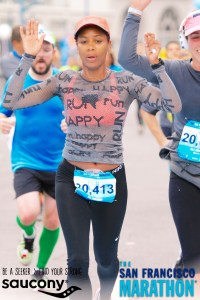
The San Francisco Marathon (SF Marathon) was a dream hills course, that is, if you ever have such dreams or nightmares. Lol. Truthfully, I wouldn’t describe it in nightmare terms because despite the hilly terrain, I enjoyed it and thought it was quite scenic and interesting. My favorite part of the course was running on the golden gate bridge (big thrill)..about three miles out from the Bay area into Marin and back to the tune of perfect San Francisco-type weather, overcast and drizzly with a cool breeze. I was in my element at tempo pace with a slight incline to relatively flat run in the company of thousands of runners and spectators lining the bridge; a perfect run setting if there ever was one, if only it could have stayed that way. But it was San Francisco, you would think I didn’t know it as I really didn’t expect it to be quite as hilly; suffice to say my expectations were surpassed. I especially wasn’t thrilled with the downhill portions of the race as it was hell on my lower back and butt cheeks but on the other hand, the variance kept the race interesting. What I knew of the law of gravity kept me sane and pushing forward on the hills and if you know anything about running downhill, then you know the momentum pretty much carries you; only there needs to be some sort of control to your running, which was the hard part, since there was no traction.
img1470592801340
Running along the bay area was another thrill. Starting from around mile 3 to 6, it was beautiful, cool, and calm around 6am looking out over the bay to the boats as they floated on the still water. The heavy fog surrounding us like a cocoon made as if to seclude us in a space where only running existed. One could feel the immense hush settling over us as we dug in and psyched ourselves for what lay ahead. Of course nothing in my training on those very miniscule hills (in comparison anyway) in Central Park, New York could have prepared me for what must have been mountains (or so it seemed at the time) I had to run. However, it was encouraging to see the locals running with slightly less effort, it gives me hope that mastering those hills is possible after all; I only have to incorporate it into my training. Only, right.
In hindsight, I should have made more of an effort to tame my pace in the first half, and to be fair I tried, but with the early ups and downs and stronger muscles to play with, pushing it kind of just happened and I was able to keep up a more or less steady 8:15 min p/mile. It was the steady decline of mile 13 that saw my decrease in pace which just about summed up the rest of the race. Getting past the historic residential areas and closer to the city provided a bit of a reprieve in terms of a flatter landscape and difference in scenery but it was a case of too little too late, as I was already heading toward a 3:50 finish. Not much that could have been done at that point and not for a lack of anything not provided on the course.
img1470592758255
The 31st running of the SF marathon ran pretty smoothly. Lots of fluid and energy gels strategically placed along the course made sure we were ready to take on the hills right up to the finish line. Crossing under the merciful covering of an overcast sky was a blessing I did not take for granted, for San Francisco’s glorious sunshine soon appeared as if out of no where. Boy was I grateful to have finished and was especially heartened to see the streams of runners that kept pouring in despite the damnable heat. 27,000 runners found their strong last Sunday, which I think speaks a lot to what determination, perseverance and the right attitude can do when coupled with a runner on a mission. That said, it’s a course I’d love to run again; maybe I’m a sucker for punishment after all.
img1470592870351

A 10k of Woman Power: 8,833 strong

img1466271126204.jpg

Last Saturday 8,833 female runners took over Central Park for the 45th running of the original all-women mini 10k for which the run was aptly named as it celebrates women’s advancement in the field of running. It was a hot and beautiful day, not an ideal race day, but the stellar cast of elite women headlining the race, who are set to represent us at this summer’s Olympics, provided ample motivation for the rest of us.

It was a heartening sight, to witness and be a part of an occasion of such monumental significance. While I’ve only been in this country for about 10 years, I’ve been a runner for twice that time and have read about as well as observed the strides women are making in the sport of running. This makes me firstly a proud woman, then a proud runner.

We took to the street, all 8,000+ of us in an array of pinks; women from all over the world in the splendor of diversity and rolled out wave after wave for all intents and purposes united in the cause of woman power. Beyonce’s “Who run the world” might have been our anthem as we raced up Central Park West and headed into the the park at West 90th street. Of course the answer was girls, girls and more girls..taking on 6.2 rolling miles of Central Park to the cheers and support of spectators lining the course.

Jemima Sumgong of Kenya led the way in a heat-defying time of 31:26 but whether you finished under an hour or as much as 3 hours later, each woman out there had something to be proud of. Truth is, in a city such as New York there is possibly 8,833 other things either of us could have been doing. For sure we had varying goals going in – many of us were looking for PRs – but I’d wager that we all had one overwhelming desire that day and it was to make our mark as women; to represent an international community of womanhood and to celebrate our powerful presence in the greatest city in the world. We did it and then some! #werunthiscity #proudnewyorker #womenrunners

A Check-In with our 2016 Running Goals

2016-predictions-930x527

“The trouble with not having a goal is that you could spend the rest of your life running up and down the field and never score.” – Bill Copeland

We’re back in “running” business! It’s always a struggle to get runners to rest up, mainly because we’re too afraid of losing momentum. We often think that we will have to fight our way back in as the body can become quite use to being on vacation. There may be some merit to that but only to the extent that a break amounts to weeks or months off. Surely it can’t mean one will suffer a setback if he or she takes a well-deserved couple of weeks off? In fact, struggle or not, coming back from my two weeks off feels great and based on my running this week, its all good. You can breathe and rest easy now; two weeks will make you not break you.

Also, we can get ready for better running weather, for it’s May and we’re on the brink of summer – how did that happen? In any event, this is a good time to stop and reassess or check-in regarding our running goals for this year. Yep, the very same ones we were all excited and up in arms about around January 1st of this year. You’re totally entitled to a bit of guilt if you’re nowhere where you want to be, but know that it’s ok. You’re here, healthy (hopefully) and so happily you can give it another shot.

A big goal of mine was running the Boston Marathon so.. check – not the desired result – but it’s done. Even so, there are other races on my agenda, others I still have to do. What is interesting to note is that as I cross one item of my list, it actually has bearing on my other goals in a real way. Take for example Boston, I have now decided to run it again next year, to earn my medal this time, if my registration is accepted. As a result of this decision, I’ll try for a better qualifying time in Chicago this year. It’s a little crazy how it never stops with me; it’s as though there will always be another goal, another race. Maybe there always will be, but goals do many things, chief among them is to inspire us to give of our very best and even if we fail, we get up, stomp the dust off and try again.                                                          

In the upcoming months, (half the year is almost up, unbelievable), I have two, maybe three, big races and a few smaller ones while I have my heart set on a 5k and Half-Marathon PR. Additionally, I have a charity goal to fulfill which I will do at the Chicago Marathon. Because summer is usually an all-round hot time, I will be limiting my runs to fun, short ones with one destination marathon in July.                                             

I jokingly say that my life is a scatter plot, with my running all over the graph. But despite how it seems, it keeps me focused and happy – the world could go to pieces around me, as long as I’m running, it’s fine. LOL! I’m kidding! It’s really not that bad, just a tad bit crazy (my friends would say). Regardless, I’m no fine running example as I have fallen off the goal wagon a time or two. For yet another year, I’ve been terrible with keeping count of my miles while I can’t seem to start the tri program just yet. I try to convince myself that maybe I will in the summer but in the meantime between getting a handle on my health ( making sure I’m fit as a fiddle) and getting coached to improve my time, and working and keeping up with my volunteer activities, I’m a little stretched for time. While I’m not complaining, since that’s the way I like it, I would love time to slow down just a tad and maybe someone up there can add a few more hours to my days? Just saying.

A Marathon Frame of Mind: Boston Strong

Sports-Illustrated-Boston-Strong-2014-spread_1

source: wcvb.com

Just a few more days left to go, two and some to be more precise, and for a while there I was wondering if it would ever get here. Now there’s a part of me silently screaming that it’s all too much too soon, while the other part – the marathoner – is yelling to bring it on.

Only one time before have I felt anything other than excitement at a big run such as this, you may recall my first marathon – the New York City Marathon – which I ran with a sprained ankle. Back then, I had a similar feeling of trepidation, which didn’t result in any great feat accomplished except to probably make me the only person crazy enough to run 26.2 miles with pain and a hobble. Fast forward to Monday coming, seven marathons later and a 100% belief in my ability to finish.

Today’s bit of anxiety really stems from “the elephant in the room” also known as my breathing problem and now becoming popular among athletes, Exercise Induced Asthma. My acceptance of this diagnosis is cynical at best while the reality is much less so and one I must run with; and so my concern is really about my finish time. This may seem silly – here I am with a very real health issue and yet all I can think about is a goal time. Well try not to judge me too harshly. I promise you, run enough marathons and the question becomes not about finishing, which is a given, but only “in what time.” That being said, I’m by no means nonchalant about my condition, only aware of my body and its evolving boundaries, which I think I’m becoming quite good at exploring and extending bit by bit. This is my comfort and that which gives me hope going in to Boston.

I can absolutely do this. The training is done and I’m as ready as I will ever be at this point. I look forward to a phenomenal experience: the new course, amazing spectators, good weather (we can only hope), and an all-round fun time. Determidly so, I might add, because I’m mindful that I’ll be running in the footsteps of all those who have gone before me, in the spirit of all those who hope to come after and for those who can only dream.

As such, in the spirit of Boston, on this the third anniversary of fhe Boston Marathon bombings, along with the survivors and those who lost their lives on that fateful Marathon Monday in 2013, I promise to run Boston Strong.

My Pacing Problem

pace4

source: usafmarathon.com

Pacing is a very important issue for runners, runners who are concerned with optimal performance that is. The average runner will have a goal of what he/she would like his/her next 5k, 10k, half-marathon or full marathon time to be and if he or she is really serious about it then that runner will have a plan or pacing strategy to make it happen. It is a common belief among coaches and athletes alike that practicing proper pacing will bring about running success and ensure you achieve your highest potential. Said professionals believe that pacing is not necessarily a natural ability but a skill that can be refined and sharpened through practice and training in your tempo runs and interval sessions.

We’ve often heard the cliché expression – pace yourself – and while it maybe an overused euphemism it applies just as much to running as to other areas of life and maybe even more importantly so. “Running the correct pace can be the difference between running a personal record or not,” says Coach Richard Airey. In other words, you start off too fast and you run the risk of burnout or you get caught up in the race excitement and allow the race to dictate your pace, the result being you end up running much faster in the beginning leading to a forced and much slower finish.

The newbie or inexperienced runner is susceptible to this as so often we are driven by competition. It takes only the thought that someone will out-perform you to get your juices flowing and you’re off but it is the disciplined and experienced runner who understands that in most cases or races placing and medals happen at the finish line, which could be twenty-five miles down the road.

Enter me, certainly not a newbie but not quite so sure I fit in the category of experienced, or maybe it’s just that I’m not very disciplined, whatever it is and for sure it’s something, I continue to be challenged by this pacing concept. Oftentimes, if I race with a pacer, and this certainly is an option where available, I tend to do pretty well. On the other hand, left to my own devices, I usually end up struggling with an even pace for any race greater than a half-marathon. Too, I have tried running negative splits (second half of the race faster than the first) and have only been marginally successful with that. There is empirical evidence to support this as the most efficient and effective way to attain your goal with studies showing that record holders from 1500 meters to marathons have been negative-split runners, see here: http://www.ncbi.nlm.nih.gov/pubmed/19116437 I have been told this can be remedied with coaching and practice. Since I have been practicing, I can only deduce that discipline is lacking and thus I feel I can benefit from a one-on-one approach. If skill is indeed what this pacing thing is about, I feel more than equipped, only I need those skills honed and developed.

With Boston in mind, I have been focusing on speedwork: tempo runs, hill repeats and interval sessions. Maybe I can benefit from some track work; though with all the cold airof late, my breathing has been taking a beating. I can only hope this leads to something good. Off to find a coach, wish me luck!


Character Traits of the Successful Runner

f767a803900f5a92465a73f5fd375732~2

Cold and brutal weather brings about varying responses from many of us. In the northern parts of the United States, many people are very tolerant of this kind of weather and even enjoy it. Maybe it has to do with their having settled here by choice or their having acclimatized easy enough; whatever the reason, you will find arguments for and against running in the worst of winter and runners enough in support of layering, lacing up and braving the elements.

In my view, it says a lot about the character of one who is able to put aside discomfort, unpleasantness, disappointment, inconvenience – snow storm and minus temps anyone – and a lot of other obstacles that define the running life while continuing to steadfastly pursue a course of action that sure enough has its inherent dangers, but also holds the promise of sweet success. Such a runner, in my humble opinion, is above average and subscribes to a set of defining traits and/or qualities that places him or her far above the rest.
The successful runner must have:
  • Passion – a desire and drive for the Sport of running that inspires excitement and commitment for follow-through even when the going is rough.
  • Perseverance – the wherewithal to patiently stay the course: sticking to workout schedules and training plans to ensure the desired outcome.
  • Confidence – an innate belief in oneself and one’s ability and in one’s coach and/or training plan.
  • Determination/Tenacity – holding fast to one’s belief and running MO through a demonstrated willingness to overcome obstacles and hindrances seeing them only as temporary setbacks on the part to success.
  • Focus – the ability to keep one’s eye on the goal at all times.
  • Resilience – that unique ability to bounce back after disappointments keeping focus and form.

There’s nothing like winter weather to draw us out, in many cases sifting us only to find us wanting.. or human.. though often enough it will find those of us who embrace the challenge of winter weather, using it to vilify us and our dreams of being counted among those who belong to that exclusive club of successful runners.

Previous Older Entries Next Newer Entries

Enter your email address to follow this blog and receive notifications of new posts by email.

Join 288 other subscribers